

Rimbaud wrote “Voyelles” before he was old enough to vote, and it’s still one of the strangest, most argued-over sonnets in French. Fourteen lines assign a color to each vowel — A is black, E is white, I is red, U is green, O is blue — and then spend the rest of the poem trying to justify it. Scholars still don’t agree on whether he meant it literally. This page walks through the poem, the life around it, and the five very different translations kept alongside it here.
Who Was Arthur Rimbaud?
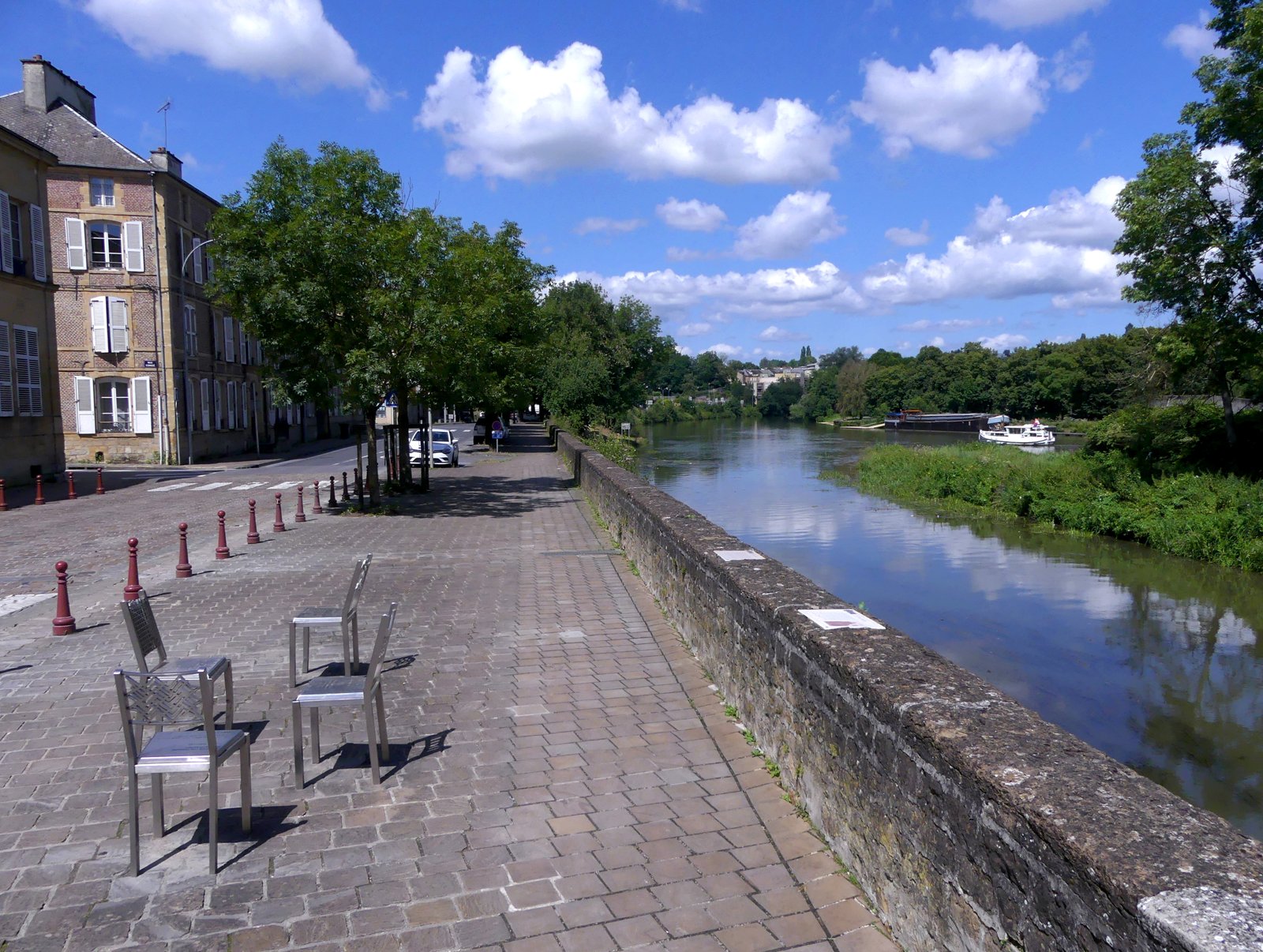
Rimbaud was born in 1854 in Charleville, a provincial town in northeastern France he spent most of his adolescence trying to escape. He was, by every account, a genuine prodigy — fluent in Latin verse as a schoolboy, publishing his first poems at sixteen, and finished with essentially his entire literary output by the time he was twenty. “Voyelles” was written around 1871 or 1872, somewhere in the middle of that short, concentrated burst.
Then, sometime in his early twenties, he simply stopped. Not slowed down — stopped, completely and permanently, and never wrote another line of poetry for the last fifteen years of his life. That break is as much a part of his reputation as anything he wrote.
Verlaine, and the Circle Around “Voyelles”
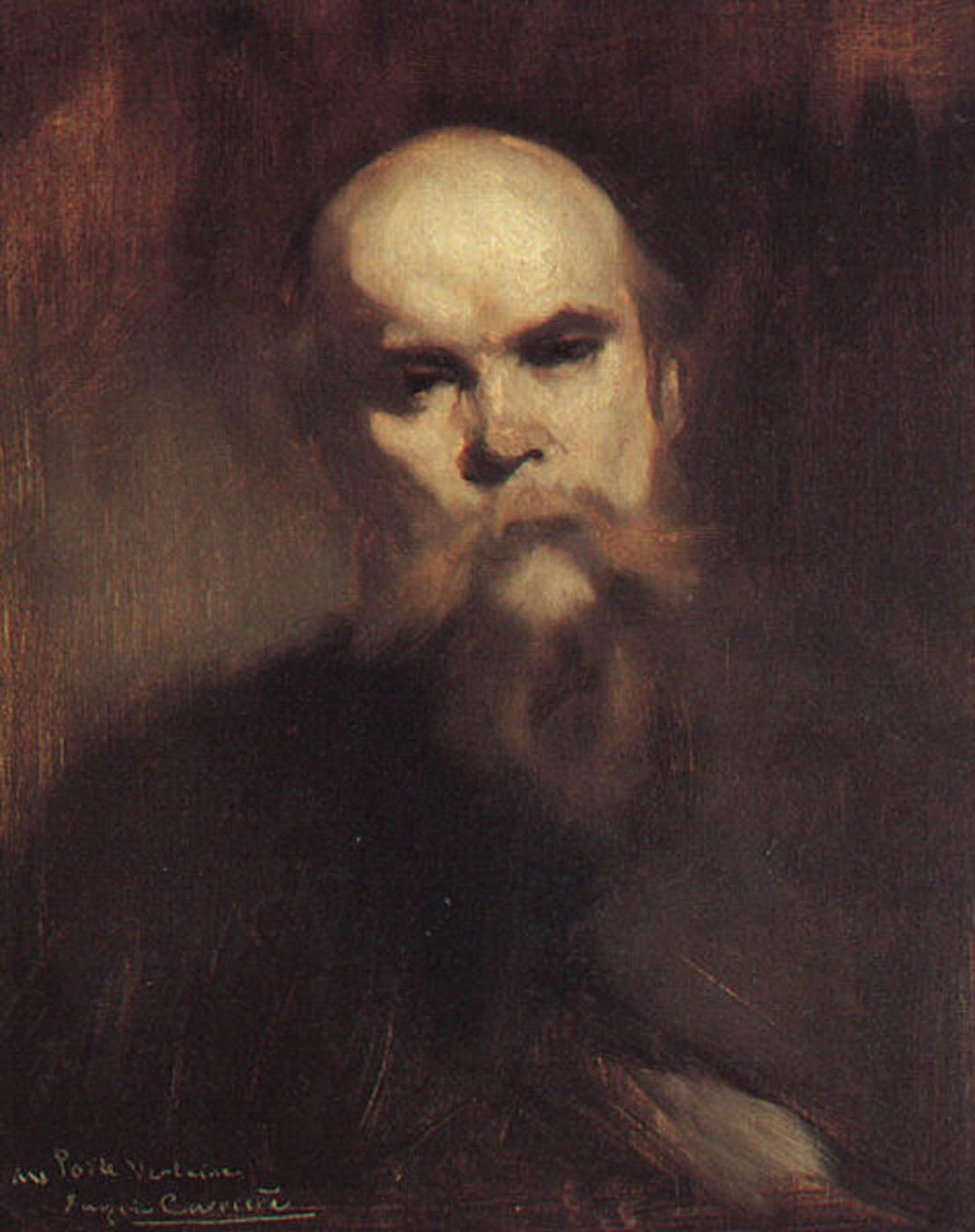
In 1871, the teenage Rimbaud sent his poems to Paul Verlaine, already an established poet a decade his senior. Verlaine was floored, invited him to Paris, and the two began a relationship — personal and artistic — that was as volatile as anything either of them wrote. It ended in 1873 when Verlaine, drunk and despairing, shot Rimbaud in the wrist in a Brussels hotel room and served eighteen months in prison for it.
“Voyelles” circulated in this world before it was ever formally published — passed among the Paris poets Rimbaud ran with in the early 1870s, including the deliberately provocative drinking club known as the Cercle Zutique. It wasn’t printed until 1883, in an essay by Verlaine, by which point Rimbaud had already left poetry behind entirely.
“Voyelles”: The Poem That Colors the Alphabet
The premise is simple to state and hard to pin down: A is black, E is white, I is red, U is green, O is blue, and each color then unfurls into a small cluster of images — A as a corset of black flies, O as a violet ray from a pair of eyes. Whether Rimbaud actually experienced sound-color synesthesia, was borrowing from a children’s alphabet primer with colored letters, or simply invented the scheme for effect, is a genuine, unresolved argument among scholars. He never explained it, and the poem offers no key.
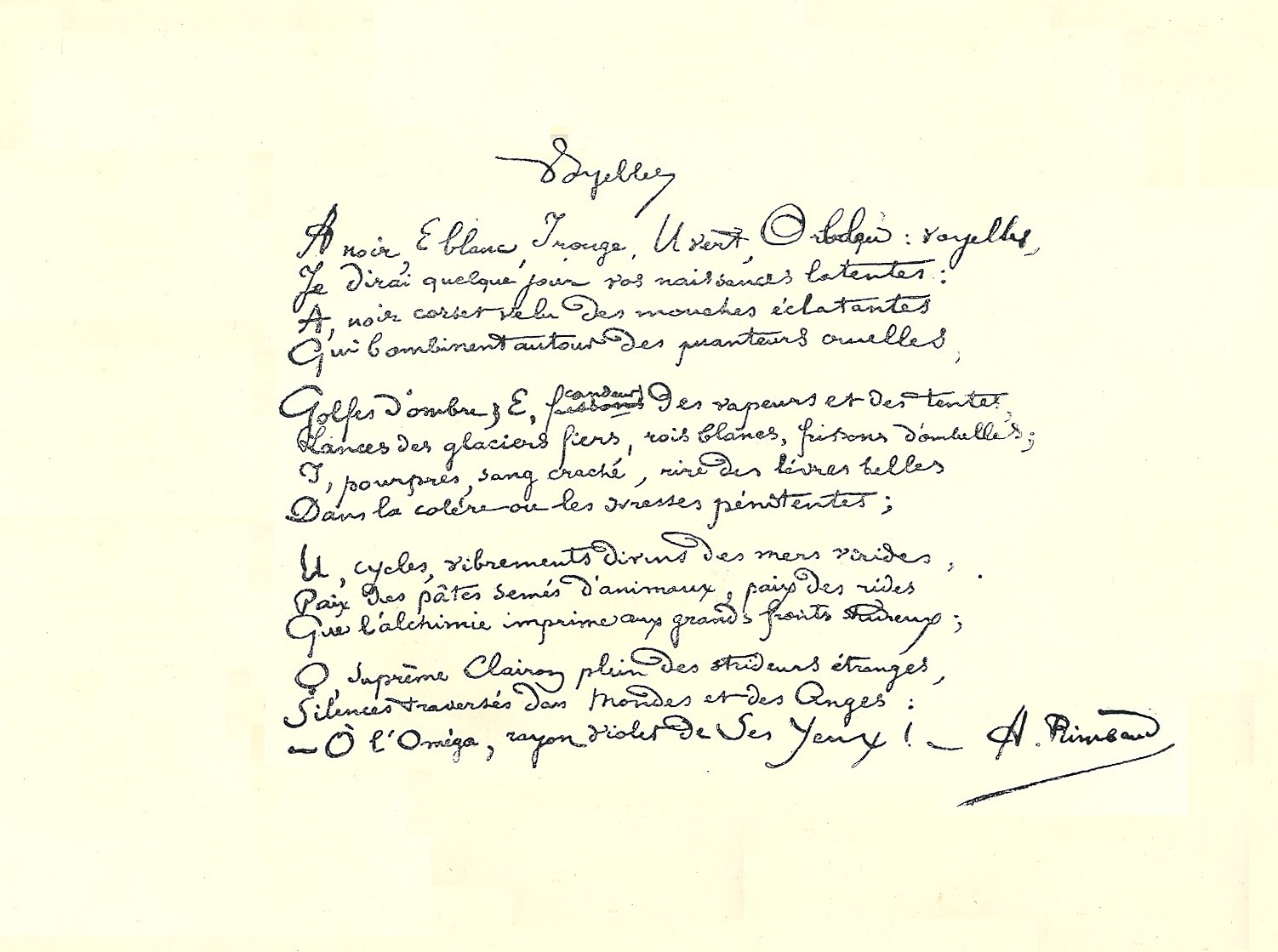
What isn’t in dispute is the poem’s influence. “Voyelles” became a founding text for later writers interested in the correspondence between senses — sound as color, color as sound — an idea the Symbolist poets after Rimbaud took up directly, and one that shows up, in looser form, anywhere a writer treats language as something felt on the skin rather than just read.

Five Ways to Translate an Untranslatable Poem
Part of what makes “Voyelles” such a good test case for translation is that it operates on two levels at once — what the words mean, and what they sound like — and no translation can fully carry both across languages. The text kept on this site includes five different attempts by the poet and translator Christian Bök, each solving the problem a different way.
“Vowels” is the straightforward route: translate the meaning as closely as English allows. “Veils” abandons meaning almost entirely in favor of sound — a homophonic translation built to sound like “Voyelles” read aloud, whether or not the words make the same kind of sense. “Phonemes” keeps Rimbaud’s exact sequence of vowel sounds while replacing everything else, and “Vocables” is a full anagram, built only from the letters of the original French. The last one, “AEIOU,” strips the poem down to nothing but its vowels — every consonant, every space, gone.
Read together, the five versions make an argument of their own: that a poem this dependent on the physical texture of language can’t be translated once, only translated repeatedly, from different angles, with something different lost and kept each time.
What Happened to Rimbaud After He Stopped Writing
By his early twenties Rimbaud had walked away from literature entirely, and spent most of the rest of his short life as a trader in Yemen and later Harar, in present-day Ethiopia, dealing in coffee and, for a period, arms. He rarely mentioned his old poems and seems to have had little interest in the reputation they were quietly building back in Paris without him. He died in Marseille in 1891, at thirty-seven, after a leg amputation, from a cancer that had likely started years earlier in Africa.
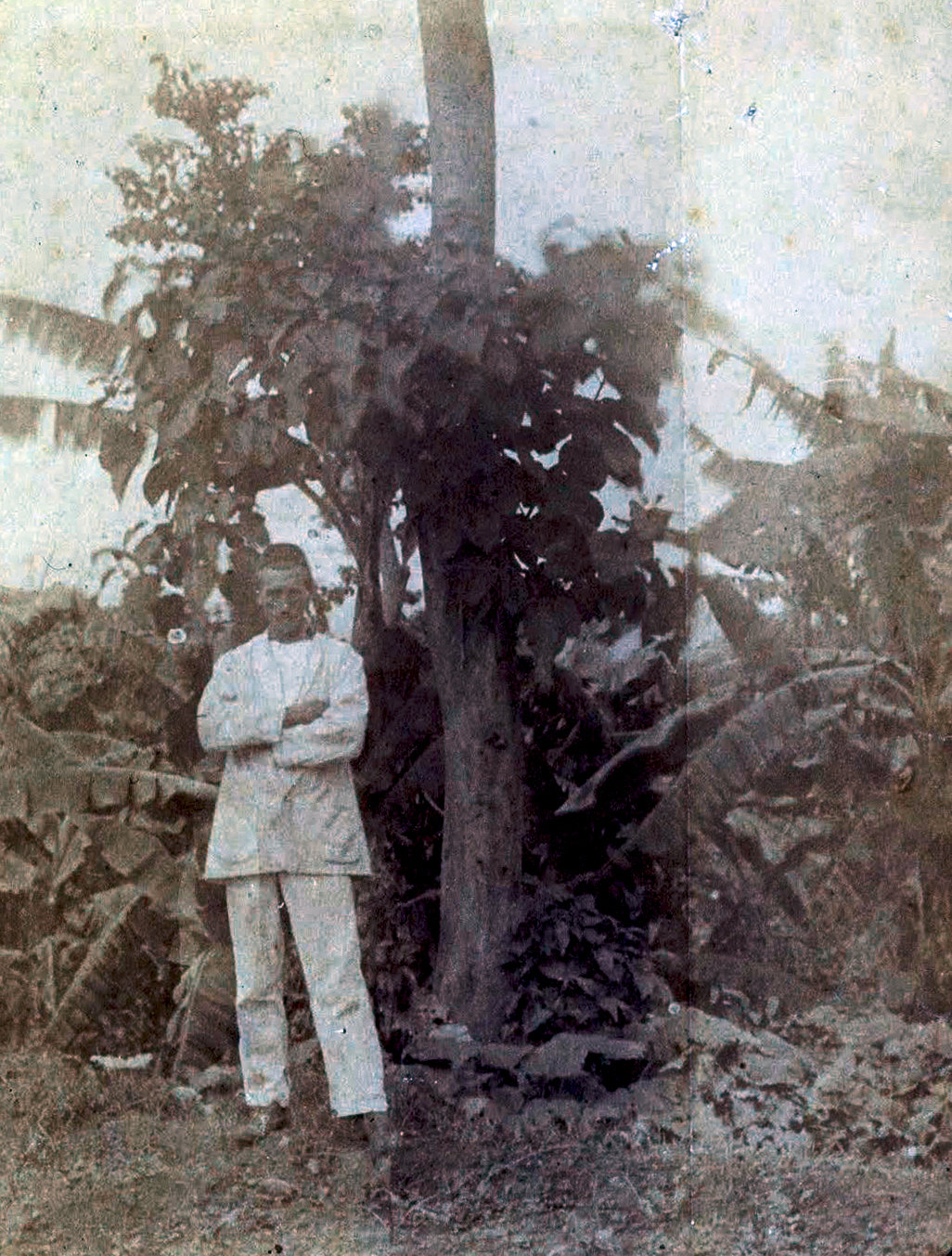
The gap between the two lives is a large part of why he still fascinates people who otherwise have no particular interest in French Symbolist poetry: a teenager writes some of the most technically daring verse of the century, then spends his adulthood as a merchant who, by most accounts, would rather not have discussed it.
Why “Voyelles” Still Matters
What keeps “Voyelles” alive isn’t that it solved anything — it’s that it took a private, unverifiable sensation and insisted it belonged on the page, argument or no argument. That’s a smaller, stranger cousin of the same instinct behind the philosophy shelf here: pushing on a claim about experience that can’t quite be proven, just to see what it opens up. If you want the fuller, book-length version of that instinct, Hegel’s Science of Logic is on the shelf too, and if you’d rather stay with poets who wrote toward death and image the way Rimbaud wrote toward color, Lorca’s selected poems are a natural next stop.
Read the Full Text
The full text of “Voyelles” in the original French, alongside all five of Christian Bök’s translations, is available to download below, or return to the full poetry collection for Lorca, Eliot and the Epic of Gilgamesh.
Frequently Asked Questions
What does “Voyelles” mean?
“Voyelles” (“Vowels”) is a sonnet by Arthur Rimbaud that assigns a color to each of the five French vowels — A black, E white, I red, U green, O blue — and builds a cluster of images around each one. Rimbaud never explained the system, and whether he meant it as literal synesthesia or invented wordplay is still debated.
Who was Arthur Rimbaud?
Rimbaud (1854–1891) was a French poet who wrote almost his entire body of work before the age of twenty-one, then abandoned literature completely and spent his later life as a trader in Yemen and Ethiopia. He died in Marseille at thirty-seven.
What was Rimbaud’s relationship with Paul Verlaine?
Verlaine, an established poet a decade older, became Rimbaud’s mentor and lover after Rimbaud sent him poems in 1871. The relationship ended violently in 1873 when Verlaine shot Rimbaud during an argument in Brussels.
Why are there five different translations of the poem here?
Because “Voyelles” depends as much on how it sounds as on what it means, no single translation can carry both. The five versions by Christian Bök included here each prioritize something different: literal meaning, sound, vowel pattern, anagram, or pure vowel content.
Why did Rimbaud stop writing poetry?
He never gave a clear public explanation. By his early twenties he had left literary Paris behind for trading work abroad, and rarely discussed his old poems again before his death in 1891.
For more on the person keeping this shelf, read about me, or explore the rest of the poetry collection.